
When Life Hurts: What the Bible Actually Says About Suffering or Why Does a Good God Allow Pain?
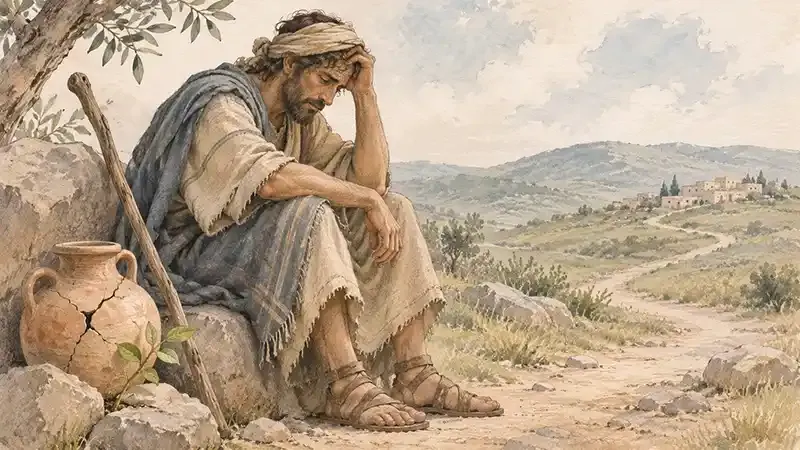
If you are reading this article, there is a good chance this isn't just a philosophical puzzle for you.
Maybe you are carrying a grief that hasn't lifted. Maybe you watched someone you love suffer unfairly, or you look at the news and feel sick over the cruelty in the world. And maybe, when you brought that pain to religious people, they handed you a shallow phrase like "You just need to have more faith" or "God needed another angel."
If those answers made you want to walk away from faith—or walk away from the Bible altogether—that is completely understandable. When you are hurting, a dismissive shortcut doesn't comfort you; it makes you feel unseen.
The truth is, the question of suffering is one of the hardest questions in human life. The Bible does not hand you a cold, tidy formula to make the pain disappear overnight. What it offers instead is something much more honest—and much more grounded.
The Bible itself rejects shallow answers
One of the biggest surprises for people who actually read the Bible is how much it pushes back against religious clichés.
There is an entire book in the Old Testament—the book of Job—about a good man who loses his children, his livelihood, and his health in a single stretch of tragedy. When his friends arrive to comfort him, they start out doing the one thing that actually helps: they sit with him in silence.
When three of Job's friends heard of the tragedy he had suffered, they got together and traveled from their homes to comfort and console him. Their names were Eliphaz the Temanite, Bildad the Shuhite, and Zophar the Naamathite. When they saw Job from a distance, they scarcely recognized him. Wailing loudly, they tore their robes and threw dust into the air over their heads to show their grief. Then they sat on the ground with him for seven days and nights. No one said a word to Job, for they saw that his suffering was too great for words.( Job 2:11-13 )
Then, unfortunately, they start talking. For over thirty chapters, his friends try to defend God with a simple, rigid rule: good people always prosper, and bad things only happen to people who deserve them. By their logic, Job must have committed some secret sin to bring this tragedy on himself.
Job refuses to accept their neat formula. He argues back, gets angry, and demands answers from God. At the very end of the book, God finally speaks—and he doesn't praise the religious friends for their tidy speeches. He actually tells them they were wrong, and defends Job’s raw honesty:
After the LORD had finished speaking to Job, he said to Eliphaz the Temanite: "I am angry with you and your two friends, for you have not spoken accurately about me, as my servant Job has.( Job 42:7 )
Centuries later, Jesus did the exact same thing. When people asked him about a tragic accident where a tower collapsed and killed eighteen people, he flatly rejected the idea that the victims somehow deserved it:
About this time Jesus was informed that Pilate had murdered some people from Galilee as they were offering sacrifices at the Temple. "Do you think those Galileans were worse sinners than all the other people from Galilee?" Jesus asked. "Is that why they suffered? Not at all! And you will perish, too, unless you repent of your sins and turn to God. And what about the eighteen people who died when the tower in Siloam fell on them? Were they the worst sinners in Jerusalem? No, and I tell you again that unless you repent, you will perish, too."( Luke 13:1-5 )
If someone has ever jumped to the conclusion that your suffering must be a hidden punishment, you can know right now: the Bible does not support that kind of one-sided assumption.
You are allowed to be angry and confused
Many people leave religion because they feel they have to put on a fake smile and pretend everything is fine.
In the Bible, you never have to pretend. Over a third of the book of Psalms—the ancient songbook of Israel—is made up of laments: raw, unfiltered cries of anger, grief, and confusion aimed straight at God.
O LORD, why do you stand so far away? Why do you hide when I am in trouble?( Psalms 10:1 )
How long, O LORD, must I call for help? But you do not listen! "Violence is everywhere!" I cry, but you do not come to save. Must I forever see these evil deeds? Why must I watch all this misery? Wherever I look, I see destruction and violence. I am surrounded by people who love to argue and fight.( Habakkuk 1:2-3 )
These writers didn't hide their frustration. They looked at injustice and asked, "Where are you? Why are you letting this happen?" The fact that these words were preserved inside Scripture tells you something important: honest grief and hard questions are not the opposite of faith. They are often where real honesty begins.
Why doesn’t God just stop all evil right now?
Even when we clear away the clichés, the hard intellectual question remains: If God is all-powerful and all-good, why doesn't he just step in and stop suffering?
The Bible points to two big realities that help explain the tension.
First, the Bible says the world we live in today is not the world God originally designed. It describes a creation that is deeply fractured—almost like a living thing groaning under the weight of brokenness:
And to the man he said, "Since you listened to your wife and ate from the tree whose fruit I commanded you not to eat, the ground is cursed because of you. All your life you will struggle to scratch a living from it. It will grow thorns and thistles for you, though you will eat of its grains. By the sweat of your brow will you have food to eat until you return to the ground from which you were made. For you were made from dust, and to dust you will return."( Genesis 3:17-19 )
For we know that all creation has been groaning as in the pains of childbirth right up to the present time.( Romans 8:22 )
Second, the Bible takes human freedom seriously. Real love, kindness, and courage only exist if people have the genuine choice to love—or to refuse to love. A world where God forced every person to be good, or froze every harmful choice before it happened, would be a world of robots, not real relationships.
That doesn't make human cruelty any less heartbreaking. It simply reminds us that the Bible never claims this broken world is the way things were meant to stay.
Unseen reasons, steady presence
At the same time, the Bible never says that your life is just random chaos, or that God has lost control of the world.
Scripture teaches that God is deeply attentive—nothing happens outside his notice, and he always has a reason for what he does or allows, even when that reason is completely hidden from us. Jesus used a simple, tender picture from nature to explain how closely God watches over every single life:
"What is the price of five sparrows-- two copper coins? Yet God does not forget a single one of them. And the very hairs on your head are all numbered. So don't be afraid; you are more valuable to God than a whole flock of sparrows.( Luke 12:6-7 )
Not even a tiny sparrow is forgotten, and every detail of your life is known to him. In the Old Testament, the book of Psalms paints a similar picture—that God is not distant, but is actively close by, guiding and steadying our steps through every season:
The LORD directs the steps of the godly. He delights in every detail of their lives.( Psalms 37:23 )
Here is the honest tension the Bible holds: God always has a purpose, but we do not always get to see what it is right now.
Imagine someone from five hundred years ago stepping into a modern operating room. They see a doctor using a sharp blade to cut into a sleeping person. Without knowing anything about modern medicine, anesthesia, or how the human body heals, what would they feel? Probably horror and anger. They might even try to stop the doctor, convinced they were watching an act of cruelty. They simply wouldn't have the perspective to see that the surgeon is actually saving a life.
The Bible suggests that the gap between our perspective and God’s is even wider than that:
"My thoughts are nothing like your thoughts," says the LORD. "And my ways are far beyond anything you could imagine. For just as the heavens are higher than the earth, so my ways are higher than your ways and my thoughts higher than your thoughts.( Isaiah 55:8-9 )
Just as Job never got to see the behind-the-scenes story of his own trial, we are often left in the dark about the why. What the Bible offers us in the meantime isn't a full explanation—it is the confidence that we are not forgotten, and that God is right beside us at every step.
A God who doesn’t watch from a distance
What makes the Bible's view of suffering unique is that it doesn't picture God sitting safely in the clouds, untouched by human pain. It pictures God stepping directly into it.
Look at a quiet, stunning moment in the life of Jesus. His close friend Lazarus has just died. Jesus knows he is about to perform a miracle—yet when he sees Lazarus's sisters grieving, he doesn't give them a lecture. He breaks down and cries with them:
When Jesus saw her weeping and saw the other people wailing with her, a deep anger welled up within him, and he was deeply troubled. "Where have you put him?" he asked them.They told him, "Lord, come and see." Then Jesus wept.( John 11:33-35 )
And at the center of the New Testament is the cross—a story of unfair arrest, betrayal, torture, and death. On the cross, Jesus even cries out the words of an ancient psalm about feeling completely abandoned:
He was despised and rejected-- a man of sorrows, acquainted with deepest grief. We turned our backs on him and looked the other way. He was despised, and we did not care. Yet it was our weaknesses he carried; it was our sorrows that weighed him down. And we thought his troubles were a punishment from God, a punishment for his own sins!( Isaiah 53:3-4 )
At about three o'clock, Jesus called out with a loud voice, "Eli, Eli, lema sabachthani?" which means "My God, my God, why have you abandoned me?"( Matthew 27:46 )
My God, my God, why have you abandoned me? Why are you so far away when I groan for help?( Psalms 22:1 )
Whatever else you decide to believe about Jesus, the story makes one thing clear: the God of the Bible is not a stranger to suffering. He knows what it feels like to be betrayed, to grieve, and to walk through the dark.
Close in the dark, and a story that isn’t finished
If you are walking through a heavy season right now, you may not get every answer you are looking for today. What the Bible promises instead are two grounded commitments:
First, that God is closest to people when their hearts are broken, not when they have it all together:
The LORD is close to the brokenhearted; he rescues those whose spirits are crushed.( Psalms 34:18 )
Second, that the story is not finished—that injustice, sickness, and grief are temporary, and a day is coming when every tear will be wiped away:
He will wipe every tear from their eyes, and there will be no more death or sorrow or crying or pain. All these things are gone forever."( Revelation 21:4 )
Take all the time you need
If you have been hurt by shallow religious answers, you don't have to rush back into anything. You don't have to force yourself to feel okay, and you don't have to pretend your questions are smaller than they are.
You are allowed to grieve honestly, ask the hardest questions you have, and take your time. If you ever decide to open the Bible again, you won't find a book asking you to hide your pain—you will find ancient voices who felt the exact same weight, and a God who promises to stay close by through all of it.
Keep exploring

It is exhausting to grow up—or just try to live—in a world where you can see a thousand people’s best moments before you even get out of bed. You…

Being hurt by someone is painful enough. Being hurt by someone who claims to speak for God is a completely different kind of wound. Maybe you grew up…

A faith made to shine — Faith is one of the most often used words in the Bible, and one of its most beautiful ideas. Yet it is easy to hold it back.…