
Is Jesus the Messiah?
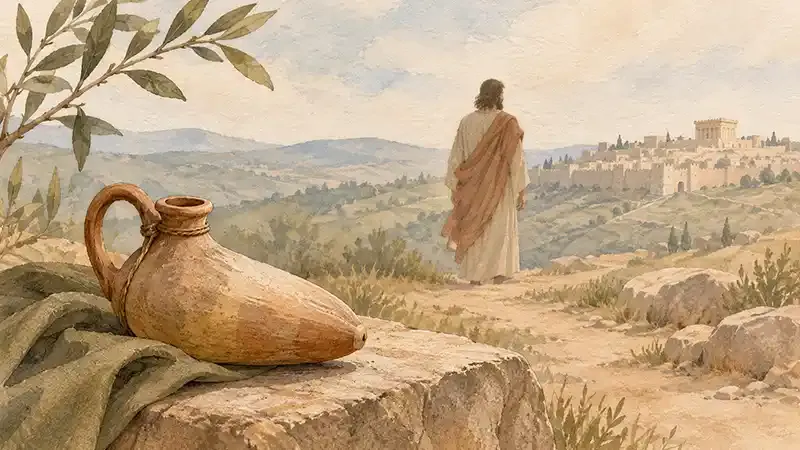
The one we were waiting for
We often hear that Jesus saved us by dying on the cross for us, and that whoever believes in him has eternal life.
Saving lives is exactly the role of the Messiah, the one Israel had long been waiting for.
But is Jesus really that Messiah? Or must we keep waiting for someone else?
Most of what we know about the chosen one comes from a single prophet, Isaiah, who lived about 700 years before Jesus was born. Let's open his book together and see what he expected, and then let the eyewitnesses of Jesus speak for themselves.
What "Messiah" means
"Messiah" comes from the Hebrew word for "anointed one." "Christ" is the same word in Greek. In ancient Israel, kings and priests were anointed with oil as a sign that God had chosen them for their task. Over the centuries, the prophets spoke of one great Anointed One who would come to rescue God's people and set the world right.
Isaiah prophesied in Jerusalem in the 8th century BC, while the mighty Assyrian empire threatened the small kingdom of Judah. A complete copy of his book was found among the Dead Sea Scrolls, written before Jesus was born.
A shoot from David's family
Isaiah pictures the royal family of King David as a great tree cut down, with only a stump left. Yet new life would grow from that stump.
Out of the stump of David's family will grow a shoot-- yes, a new Branch bearing fruit from the old root. And the Spirit of the LORD will rest on him-- the Spirit of wisdom and understanding, the Spirit of counsel and might, the Spirit of knowledge and the fear of the LORD. He will delight in obeying the LORD. He will not judge by appearance nor make a decision based on hearsay. He will give justice to the poor and make fair decisions for the exploited. The earth will shake at the force of his word, and one breath from his mouth will destroy the wicked. He will wear righteousness like a belt and truth like an undergarment.( Isaiah 11:1-5 )
The original Hebrew says "the stump of Jesse," David's father. So the "shoot" or "Branch" is a descendant of David, and that is why the Messiah was expected to come from David's line. Notice also what kind of king he is: full of God's Spirit, fair to the poor, never judging by appearance.
The New Testament opens on this very point. Matthew begins his book with Jesus' family tree, and Luke explains why Jesus was born in Bethlehem, David's hometown.
This is a record of the ancestors of Jesus the Messiah, a descendant of David and of Abraham:( Matthew 1:1 )
And because Joseph was a descendant of King David, he had to go to Bethlehem in Judea, David's ancient home. He traveled there from the village of Nazareth in Galilee.( Luke 2:4 )
Both writers took care to show that Jesus belonged to the family Isaiah's promise pointed to.
The gentle servant
Later in his book, Isaiah introduces "the servant of the LORD." Four of these passages are often called the Servant Songs (in Isaiah 42, 49, 50 and 52-53). Here is the first one.
"Look at my servant, whom I strengthen. He is my chosen one, who pleases me. I have put my Spirit upon him. He will bring justice to the nations. He will not shout or raise his voice in public. He will not crush the weakest reed or put out a flickering candle. He will bring justice to all who have been wronged. He will not falter or lose heart until justice prevails throughout the earth. Even distant lands beyond the sea will wait for his instruction. "( Isaiah 42:1-4 )
God, the LORD, created the heavens and stretched them out. He created the earth and everything in it. He gives breath to everyone, life to everyone who walks the earth. And it is he who says, "I, the LORD, have called you to demonstrate my righteousness. I will take you by the hand and guard you, and I will give you to my people, Israel, as a symbol of my covenant with them. And you will be a light to guide the nations. You will open the eyes of the blind. You will free the captives from prison, releasing those who sit in dark dungeons.( Isaiah 42:5-7 )
This servant is humble. He does not shout or raise his voice in public, and he is so gentle that he would not break a bruised reed. Yet he brings justice to the whole earth, becomes a light to the nations, and opens the eyes of the blind. Strength through gentleness was not what people expected from a rescuer. Christians read the king of Isaiah 11 and this servant as one person; many Jewish readers understand the servant as Israel itself.
A Messiah we rejected
How would people treat the Messiah? What would happen to him, and what would it mean for us? Isaiah's fourth Servant Song answers in a surprising way. It fast-forwards into the future and speaks as if it has already happened, as if the Messiah has come and we have already turned him away. It begins with the servant lifted high, yet first wounded beyond recognition.
See, my servant will prosper; he will be highly exalted. But many were amazed when they saw him. His face was so disfigured he seemed hardly human, and from his appearance, one would scarcely know he was a man. And he will startle many nations. Kings will stand speechless in his presence. For they will see what they had not been told; they will understand what they had not heard about.( Isaiah 52:13-15 )
Who has believed our message? To whom has the LORD revealed his powerful arm? My servant grew up in the LORD's presence like a tender green shoot, like a root in dry ground. There was nothing beautiful or majestic about his appearance, nothing to attract us to him. He was despised and rejected-- a man of sorrows, acquainted with deepest grief. We turned our backs on him and looked the other way. He was despised, and we did not care.( Isaiah 53:1-3 )
The "we" in these verses are the people who saw him and looked the other way. Nothing about him impressed anyone; he grew up "like a root in dry ground." Then the speakers make a discovery that changes everything.
Yet it was our weaknesses he carried; it was our sorrows that weighed him down. And we thought his troubles were a punishment from God, a punishment for his own sins! But he was pierced for our rebellion, crushed for our sins. He was beaten so we could be whole. He was whipped so we could be healed. All of us, like sheep, have strayed away. We have left God's paths to follow our own. Yet the LORD laid on him the sins of us all.( Isaiah 53:4-6 )
He was oppressed and treated harshly, yet he never said a word. He was led like a lamb to the slaughter. And as a sheep is silent before the shearers, he did not open his mouth. Unjustly condemned, he was led away. No one cared that he died without descendants, that his life was cut short in midstream. But he was struck down for the rebellion of my people. He had done no wrong and had never deceived anyone. But he was buried like a criminal; he was put in a rich man's grave.( Isaiah 53:7-9 )
They thought he was being punished for his own sins, but he was carrying theirs, and ours. The lamb is an image from Israel's worship, where a lamb was offered as a sacrifice for sin. Like that lamb, the servant stays silent, is condemned unjustly, and dies for the rebellion of others. The rejected and despised Messiah dies for our sins.
Death is not the end
Then the song ends in a way no one would expect for a man who has just been buried.
But it was the LORD's good plan to crush him and cause him grief. Yet when his life is made an offering for sin, he will have many descendants. He will enjoy a long life, and the LORD's good plan will prosper in his hands. When he sees all that is accomplished by his anguish, he will be satisfied. And because of his experience, my righteous servant will make it possible for many to be counted righteous, for he will bear all their sins. I will give him the honors of a victorious soldier, because he exposed himself to death. He was counted among the rebels. He bore the sins of many and interceded for rebels.( Isaiah 53:10-12 )
Here is a gentle mystery. Verse 8 said he died without descendants, his life cut short. Yet verse 10 says he will have many descendants and enjoy a long life. How can someone who has died live long and have children? The most natural reading is that death will not be the end for him: he will live again after dying, whether on earth or in heaven.
His "descendants" may be children by birth, or spiritual children: people who receive new life because of what he did. Christians believe this came true in Jesus, who rose on the third day and whose spiritual family now fills the world. Jewish readers often understand the passage differently, and their reading deserves respect.
What the Gospels tell us
Isaiah drew the portrait. The four Gospels tell the story of a man who, they say, fits it. Mark opens with his conclusion in the very first line, and Luke explains how carefully he worked.
This is the Good News about Jesus the Messiah, the Son of God. It began( Mark 1:1 )
Many people have set out to write accounts about the events that have been fulfilled among us. They used the eyewitness reports circulating among us from the early disciples. Having carefully investigated everything from the beginning, I also have decided to write a careful account for you, most honorable Theophilus, so you can be certain of the truth of everything you were taught.( Luke 1:1-4 )
Luke was a doctor and a traveling companion of the apostle Paul. He did not walk with Jesus himself, so he did what a careful researcher does: he gathered eyewitness reports and checked everything from the beginning. He also records the day Jesus stood up in his hometown synagogue and read from the scroll of Isaiah.
When he came to the village of Nazareth, his boyhood home, he went as usual to the synagogue on the Sabbath and stood up to read the Scriptures. The scroll of Isaiah the prophet was handed to him. He unrolled the scroll and found the place where this was written: "The Spirit of the Lord is upon me, for he has anointed me to bring Good News to the poor. He has sent me to proclaim that captives will be released, that the blind will see, that the oppressed will be set free, and that the time of the Lord's favor has come. " He rolled up the scroll, handed it back to the attendant, and sat down. All eyes in the synagogue looked at him intently. Then he began to speak to them. "The Scripture you've just heard has been fulfilled this very day!"( Luke 4:16-21 )
The words Jesus read, from Isaiah 61, speak of someone anointed by God's Spirit to bring good news to the poor and sight to the blind, the same gentle mission we met in Isaiah 42. His listeners understood what he was claiming. John, one of Jesus' closest friends, ends his book by naming its purpose.
The disciples saw Jesus do many other miraculous signs in addition to the ones recorded in this book. But these are written so that you may continue to believe that Jesus is the Messiah, the Son of God, and that by believing in him you will have life by the power of his name.( John 20:30-31 )
Read and decide
So is Jesus the Messiah Isaiah described, or must we wait for someone else? Jewish tradition still waits for the Messiah, and Christians believe he has come. Each answer is held sincerely, and each deserves respect. The best way to decide is not to take anyone's word for it, but to read the witnesses yourself:
- Matthew, one of the twelve disciples, who traveled with Jesus for years
- Mark, who, early Christians said, wrote down the memories of the apostle Peter
- Luke, the doctor who carefully gathered the facts about Jesus of Nazareth
- John, one of Jesus' closest friends
You are welcome to read them slowly, with Isaiah open beside them, and decide freely. If you would like to go further, Who is Jesus? is a good next step. May your reading lead you to the One who was promised.