
The role of pride and true faith
All of us want to feel respected and valued. This is natural, and it is the root of our self-esteem. Pride is a close relative of that wish. It grows when we want others to notice what we have done and what we have become. It is no surprise that the Bible speaks about pride so often. We tend to read those verses quickly and assume they are about someone else. Let's take a gentler, closer look. Here are three short verses to start with:
If you have been a fool by being proud or plotting evil, cover your mouth in shame.( Proverbs 30:32 )
He humbles the proud and brings down the arrogant city. He brings it down to the dust.( Isaiah 26:5 )
He makes them turn from doing wrong; he keeps them from pride.( Job 33:17 )
Notice the last one. God "keeps them from pride", and He does it by speaking to people again and again, as a caring parent would.
Two kinds of pride
In everyday life we use the word in two ways. One is critical: "this person was too proud to help." The other is warm: "Good job, I'm so proud of you!" The second is common in families, where parents encourage children to keep going and grow. Here are the usual definitions:
- A feeling of deep pleasure or satisfaction derived from one's own achievements, the achievements of those with whom one is closely associated, or from qualities or possessions that are widely admired.
- Consciousness of one's own dignity.
Joy in a child's success is a good thing, and nothing in the Bible discourages it. What the Bible warns about is a particular kind of pride: the belief that "I did this on my own, and I don't need anyone." That is pride that depends on ourselves instead of on God and others:
Pride leads to conflict; those who take advice are wise.( Proverbs 13:10 )
What God says about this kind of pride
The verses below describe how God responds. Notice that it is more about distance than about punishment. When we rely only on ourselves, we leave little room for Him:
And when they cry out, God does not answer because of their pride.( Job 35:12 )
You rescue the humble, but your eyes watch the proud and humiliate them.( 2 Samuel 22:28 )
Though the LORD is great, he cares for the humble, but he keeps his distance from the proud.( Psalms 138:6 )
The apostle James explains why God resists pride: because He wants to give us more.
But he gives us even more grace to stand against such evil desires. As the Scriptures say, "God opposes the proud but favors the humble."( James 4:6 )
A king who said, "I did this"
Before we draw any conclusions, let's look at a story. Nebuchadnezzar was the powerful king of Babylon. He had a troubling dream, and the prophet Daniel explained that God was giving him a warning. Daniel added a loving appeal:
" 'King Nebuchadnezzar, please accept my advice. Stop sinning and do what is right. Break from your wicked past and be merciful to the poor. Perhaps then you will continue to prosper.'( Daniel 4:27 )
A full year passed, a year of patience. Then one day, as the king looked out over his city, he said:
As he looked out across the city, he said, 'Look at this great city of Babylon! By my own mighty power, I have built this beautiful city as my royal residence to display my majestic splendor.'( Daniel 4:30 )
The warning came true almost at once:
"While these words were still in his mouth, a voice called down from heaven, 'O King Nebuchadnezzar, this message is for you! You are no longer ruler of this kingdom. You will be driven from human society. You will live in the fields with the wild animals, and you will eat grass like a cow. Seven periods of time will pass while you live this way, until you learn that the Most High rules over the kingdoms of the world and gives them to anyone he chooses.'( Daniel 4:31-32 )
Nebuchadnezzar lost everything he had been proud of. But look at how the story ends. After this time, he looked up, and he understood who was behind his achievements:
"After this time had passed, I, Nebuchadnezzar, looked up to heaven. My sanity returned, and I praised and worshiped the Most High and honored the one who lives forever. His rule is everlasting, and his kingdom is eternal. All the people of the earth are nothing compared to him. He does as he pleases among the angels of heaven and among the people of the earth. No one can stop him or say to him, 'What do you mean by doing these things?' "Now I, Nebuchadnezzar, praise and glorify and honor the King of heaven. All his acts are just and true, and he is able to humble the proud."( Daniel 4:34-35,37 )
The king learned something valuable, and his honour was restored. Perhaps we can learn the same lesson more gently, simply by reflecting on his story.
What about our own effort?
Most of us are not kings. But we often say, "I built this house with my own hands," "I started this company," or "I won this race." Isn't it fair to feel proud when we have worked hard at something that mattered to us, like a good job, a strong family or a race?
Of course effort matters. But the wise writer of Ecclesiastes noticed something about life as it looks from our side: results do not depend only on our skill and effort.
I have observed something else under the sun. The fastest runner doesn't always win the race, and the strongest warrior doesn't always win the battle. The wise sometimes go hungry, and the skillful are not necessarily wealthy. And those who are educated don't always lead successful lives. It is all decided by chance, by being in the right place at the right time.( Ecclesiastes 9:11 )
Success is never completely in our hands. And Jesus adds a comforting thought. Even the smallest details of life do not escape the Father's notice:
What is the price of two sparrows-- one copper coin? But not a single sparrow can fall to the ground without your Father knowing it.( Matthew 10:29 )
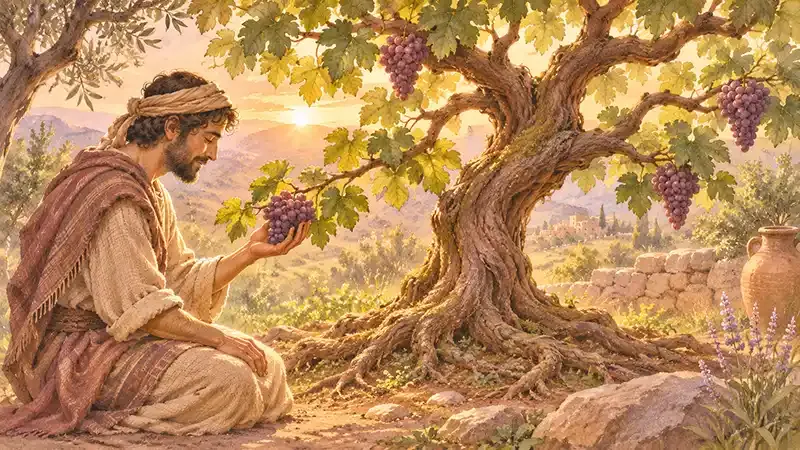
So does that mean our achievements are not really ours? Jesus answers using a picture of a vine and its branches. A branch does not make its own life. It receives it from the vine, and fruit grows from that connection. He repeats the same idea twice, in slightly different words, so that we don't miss it:
Remain in me, and I will remain in you. For a branch cannot produce fruit if it is severed from the vine, and you cannot be fruitful unless you remain in me.( John 15:4 )
"Yes, I am the vine; you are the branches. Those who remain in me, and I in them, will produce much fruit. For apart from me you can do nothing.( John 15:5 )
This is not meant to make our effort feel small. It means our abilities, ideas and strength are gifts. The Bible says this plainly:
He did all this so you would never say to yourself, 'I have achieved this wealth with my own strength and energy.' Remember the LORD your God. He is the one who gives you power to be successful, in order to fulfill the covenant he confirmed to your ancestors with an oath.( Deuteronomy 8:17-18 )
Faith: leaning on God
Pride says, "I did this by myself." Faith says, "Thank you, I couldn't have done this without You." Faith is trust, and trust gently takes the place of self-reliance:
Trust in the LORD with all your heart; do not depend on your own understanding. Seek his will in all you do, and he will show you which path to take.( Proverbs 3:5-6 )
It also takes the place of worry. When we stop carrying everything alone, we find a peace that surprises us:
Don't worry about anything; instead, pray about everything. Tell God what you need, and thank him for all he has done.( Philippians 4:6 )
And it gives us a new way to celebrate. We are free to be glad about our work, and to share the credit:
So whether you eat or drink, or whatever you do, do it all for the glory of God.( 1 Corinthians 10:31 )
Therefore, as the Scriptures say, "If you want to boast, boast only about the LORD."( 1 Corinthians 1:31 )
So let's accept our limits without shame, and take comfort in knowing that we can lean on Jesus. He walks with us through every difficulty. When pride whispers that we have to do it all alone, we can answer: there is Someone we can trust.