
The Beginner’s Map: How to Actually Read the Bible (Without Getting Lost in the Ancient World)
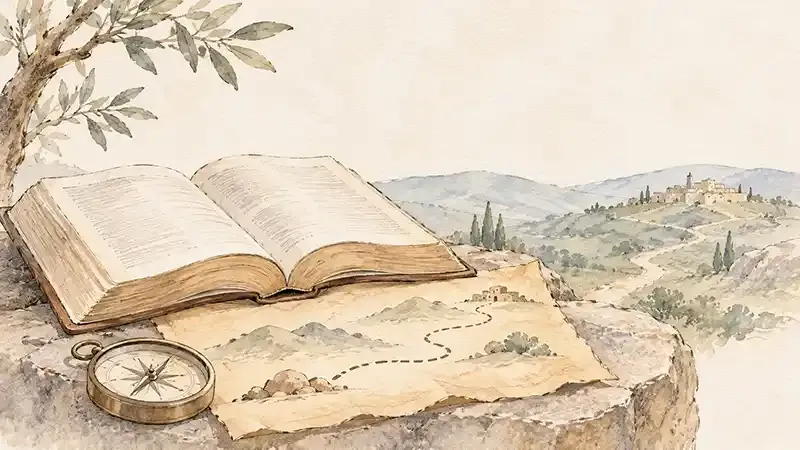
If you have ever tried to read the Bible from page one, you probably know how it ends. You start strong in Genesis, push through the drama of Exodus, and then hit a wall of ancient food laws and temple rules in Leviticus. By chapter ten, the book goes back on the shelf.
It is easy to walk away thinking the Bible is too confusing, too old, or just not for you.
Usually, the problem isn't you. The problem is that almost nobody gives you a map before you open the cover. If you read the Bible like a modern novel—starting at page one and reading straight through—you are almost guaranteed to get lost.
Here is how to find your way around, bridge the gap between the ancient world and today, and let the text speak for itself.
A library, not a single book
The first shift is simple, but it changes everything: the Bible is not one book written by one person. It is an ancient library of 66 books—written by about 40 different people, over 1,500 years, in three languages (Hebrew, Aramaic, and Greek).
Inside that library, you will find history, love poetry, laws, wisdom sayings, biographies, and personal letters. Look at how Luke, a first-century doctor, opens his biography of Jesus. He sounds much more like a careful reporter than a preacher:
Many people have set out to write accounts about the events that have been fulfilled among us. They used the eyewitness reports circulating among us from the early disciples. Having carefully investigated everything from the beginning, I also have decided to write a careful account for you, most honorable Theophilus, so you can be certain of the truth of everything you were taught.( Luke 1:1-4 )
Luke tells you right away that he talked to eyewitnesses and checked the facts so his reader could see what really happened. Knowing what kind of book you are holding before you read clears up half the confusion.
Know what kind of writing you are reading
When you open a newspaper, you read the front-page news differently from the comic strip or the opinion column. You don't get mad at a poem for using picture language, and you don't expect a recipe to have a plot twist.
The Bible works the same way. Confusion starts when we read every page like a science textbook or a rulebook. Compare these two passages from the Old Testament:
The heavens proclaim the glory of God. The skies display his craftsmanship. Day after day they continue to speak; night after night they make him known. They speak without a sound or word; their voice is never heard. Yet their message has gone throughout the earth, and their words to all the world. God has made a home in the heavens for the sun.( Psalms 19:1-4 )
Direct your children onto the right path, and when they are older, they will not leave it.( Proverbs 22:6 )
The first passage is ancient poetry. When it says the skies "speak," it isn't making a scientific claim about sound in outer space. It is using vivid imagery to show wonder.
The second passage is wisdom writing. Proverbs are general observations about how life usually works—not strict, unbreakable guarantees. When people treat a proverb like a legal promise, they feel let down when life doesn't follow a neat formula.
Watch out for ancient sayings
Every culture has sayings that make no sense if you take them word for word. If someone today says, "It's raining cats and dogs," you don't look outside for falling pets.
Ancient teachers—including Jesus—often used bold exaggeration to make a point stick in people's minds. Notice how Jesus talks about self-control:
So if your eye-- even your good eye-- causes you to lust, gouge it out and throw it away. It is better for you to lose one part of your body than for your whole body to be thrown into hell. And if your hand-- even your stronger hand-- causes you to sin, cut it off and throw it away. It is better for you to lose one part of your body than for your whole body to be thrown into hell.( Matthew 5:29-30 )
Nobody in the first century walked away thinking Jesus wanted a crowd of one-eyed, one-handed followers. His listeners immediately got the point: deal with harmful habits seriously, before they ruin your life.
In the same way, ancient writers used everyday pictures from their world—like shepherds, farmers, and kings—that hit home for their first readers:
The LORD is my shepherd; I have all that I need. He lets me rest in green meadows; he leads me beside peaceful streams. He renews my strength. He guides me along right paths, bringing honor to his name. Even when I walk through the darkest valley, I will not be afraid, for you are close beside me. Your rod and your staff protect and comfort me.( Psalms 23:1-4 )
To a modern city dweller, a shepherd sounds quaint and peaceful. To someone living in a dry, dangerous ancient landscape, a shepherd was the difference between life and death.
You are reading someone else’s mail
One of the fastest ways to misread the Bible is to pull one sentence out of its chapter and apply it straight to your week.
Almost every letter in the New Testament was written to real people facing a real problem. Before asking, "What does this mean for me?" it helps to ask, "What did this mean to the people who first read it?"
Look at two of the most famous verses in the world—this time, with the sentences around them included:
This is what the LORD says: "You will be in Babylon for seventy years. But then I will come and do for you all the good things I have promised, and I will bring you home again. For I know the plans I have for you," says the LORD. "They are plans for good and not for disaster, to give you a future and a hope.( Jeremiah 29:10-11 )
Not that I was ever in need, for I have learned how to be content with whatever I have. I know how to live on almost nothing or with everything. I have learned the secret of living in every situation, whether it is with a full stomach or empty, with plenty or little. For I can do everything through Christ, who gives me strength.( Philippians 4:11-13 )
Jeremiah 29:11 often shows up on graduation cards as a promise of quick success. In context, it was written to people who had just lost their home—telling them they would live in exile for 70 years before returning. It wasn't a promise of an easy life; it was a promise of lasting hope.
In the same way, Philippians 4:13 isn't about winning a game or getting a promotion. Paul wrote it from a Roman prison, explaining how he learned to stay steady whether he had plenty to eat or was starving. The real context doesn't make the verse weaker—it makes it much more honest.
Two halves, one big change
If you flip from the Old Testament to the New Testament, it can feel like you walked into a totally different world. Why does the Old Testament have detailed rules about clothes, food, and animal sacrifices, while the New Testament barely mentions them?
The answer is in the word Testament, which simply means agreement.
The Old Testament centers on an ancient national agreement between God and the nation of Israel, meant to set them apart as a distinct people in the ancient world:
Now if you will obey me and keep my covenant, you will be my own special treasure from among all the peoples on earth; for all the earth belongs to me. And you will be my kingdom of priests, my holy nation.' This is the message you must give to the people of Israel."( Exodus 19:5-6 )
Centuries later, Israel's own prophets wrote that this setup was not the final chapter. A new agreement was coming—one written on the human heart, not on stone tablets:
"The day is coming," says the LORD, "when I will make a new covenant with the people of Israel and Judah. This covenant will not be like the one I made with their ancestors when I took them by the hand and brought them out of the land of Egypt. They broke that covenant, though I loved them as a husband loves his wife," says the LORD. "But this is the new covenant I will make with the people of Israel on that day," says the LORD. "I will put my instructions deep within them, and I will write them on their hearts. I will be their God, and they will be my people. And they will not need to teach their neighbors, nor will they need to teach their relatives, saying, 'You should know the LORD.' For everyone, from the least to the greatest, will know me already," says the LORD. "And I will forgive their wickedness, and I will never again remember their sins."( Jeremiah 31:31-34 )
The New Testament writers explain that Jesus started this new agreement, opening it to every nation and bringing the old national rulebook to a close:
When God speaks of a "new" covenant, it means he has made the first one obsolete. It is now out of date and will soon disappear.( Hebrews 8:13 )
Seeing this big shift clears up a major stumbling block: Christians aren't just picking and choosing random Old Testament rules. They read the first half of the Bible as the backstory that leads into the second.
Reporting an action is not approving it
Many readers are shocked by the violence, lies, and bad behavior in the Bible's history books. If this is supposed to be a sacred book, why are its main characters so flawed?
A key rule for reading Bible stories is this: just because the Bible describes something doesn't mean it approves of it. The Bible is unusually blunt about human nature—it rarely hides its heroes' worst moments.
Late one afternoon, after his midday rest, David got out of bed and was walking on the roof of the palace. As he looked out over the city, he noticed a woman of unusual beauty taking a bath. He sent someone to find out who she was, and he was told, "She is Bathsheba, the daughter of Eliam and the wife of Uriah the Hittite." Then David sent messengers to get her; and when she came to the palace, he slept with her. She had just completed the purification rites after having her menstrual period. Then she returned home. Later, when Bathsheba discovered that she was pregnant, she sent David a message, saying, "I'm pregnant."( 2 Samuel 11:2-5 )
But when Peter came to Antioch, I had to oppose him to his face, for what he did was very wrong. When he first arrived, he ate with the Gentile Christians, who were not circumcised. But afterward, when some friends of James came, Peter wouldn't eat with the Gentiles anymore. He was afraid of criticism from these people who insisted on the necessity of circumcision. As a result, other Jewish Christians followed Peter's hypocrisy, and even Barnabas was led astray by their hypocrisy. When I saw that they were not following the truth of the gospel message, I said to Peter in front of all the others, "Since you, a Jew by birth, have discarded the Jewish laws and are living like a Gentile, why are you now trying to make these Gentiles follow the Jewish traditions?( Galatians 2:11-14 )
King David—celebrated as Israel's greatest king—abuses his power, cheats, and covers it up. Centuries later, in the New Testament, Paul publicly calls out Peter for hypocrisy in front of everyone.
The writers didn't include these stories as examples to copy. They included them because the text is painfully honest about how easily power and fear can corrupt anyone.
Honest doubt is already in the book
Many people stay away from the Bible because they think it demands blind faith—that you have to leave your questions at the door.
In reality, some of the rawest doubts, angriest cries, and deepest questions ever written are right inside the Bible itself:
O LORD, how long will you forget me? Forever? How long will you look the other way? How long must I struggle with anguish in my soul, with sorrow in my heart every day? How long will my enemy have the upper hand?( Psalms 13:1-2 )
"Everything is meaningless," says the Teacher, "completely meaningless!" What do people get for all their hard work under the sun? Generations come and generations go, but the earth never changes.( Ecclesiastes 1:2-4 )
The father instantly cried out, "I do believe, but help me overcome my unbelief!"( Mark 9:24 )
You will find poets asking God why he feels absent, a thinker wondering if life has any meaning at all, and a desperate father telling Jesus straight to his face that he is torn between belief and doubt. If you bring questions or frustration to the Bible, you are in very old company.
Where to start (Hint: Not page one)
If you want to explore the Bible without getting stuck, skip the cover-to-cover plan. Treat it like a library and start with the books that give you the clearest picture:
- Start with a biography of Jesus: Try the Gospel of Mark (the shortest and fastest-moving) or Luke (written by a detail-oriented historian for readers outside Jewish culture).
- Read for the big picture: Notice how John explains that he didn't try to write down everything Jesus ever did—he picked specific moments to make the story clear:
The disciples saw Jesus do many other miraculous signs in addition to the ones recorded in this book. But these are written so that you may continue to believe that Jesus is the Messiah, the Son of God, and that by believing in him you will have life by the power of his name.( John 20:30-31 )
- Add some poetry or wisdom: Read a few chapters of Psalms (for raw human emotion) or Proverbs (for practical advice) alongside a Gospel.
- Then go back to the beginning: Once you see where the story goes, reading Genesis and Exodus makes much more sense.
Take your time
You don't have to agree with everything you read on day one, and you don't need to rush. In the book of Acts, the writer actually praises a group of people in the Greek town of Berea—not because they blindly believed a speaker, but because they went home, opened the texts themselves, and checked the facts:
And the people of Berea were more open-minded than those in Thessalonica, and they listened eagerly to Paul's message. They searched the Scriptures day after day to see if Paul and Silas were teaching the truth.( Acts 17:11 )
That is still the best way to read the Bible today. Pick a modern, clear translation, keep the context in mind, ask every hard question you have, and see what you find.
Keep exploring
A lot of people genuinely want to read the Bible. Maybe you picked it up hoping for a little peace, a bit of wisdom, or honest answers to big life…
If you have ever opened the Bible, read a strange line about trees clapping their hands or a seven-headed beast rising from the sea, and quietly…
If you have ever read the Old Testament and then flipped to the New Testament, you might feel like you just walked into a completely different book.…