
Why the Old Testament Feels So Different from the New Testament (And Which Rules Still Apply)
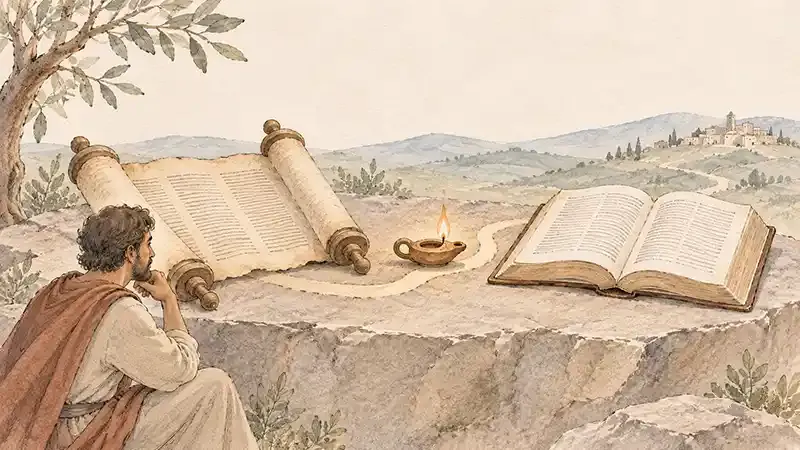
If you have ever read the Old Testament and then flipped to the New Testament, you might feel like you just walked into a completely different book.
In the first half of the Bible, there are detailed rules about not eating shellfish, not wearing clothes made of two different fabrics, and offering animal sacrifices at a temple. In the second half, almost none of those rules are followed—yet Christians still quote the Ten Commandments and the Psalms.
To a curious or skeptical reader, this can look like cherry-picking. Why do Christians keep some Old Testament rules and ignore others? And why does the mood of the two halves feel so different?
The answer isn't that Christians just skip the parts they don't like. The shift is actually built right into the Bible itself.
Two agreements, not two different books
The biggest clue is in the word Testament, which simply means agreement.
The Old Testament tells the story of a specific national agreement made between God and the ancient nation of Israel. Israel was a small nation surrounded by massive empires. God gave them a full set of laws—covering everything from religion to farming to courtroom justice—to set them apart as a distinct society:
Now if you will obey me and keep my covenant, you will be my own special treasure from among all the peoples on earth; for all the earth belongs to me. And you will be my kingdom of priests, my holy nation.' This is the message you must give to the people of Israel."( Exodus 19:5-6 )
That agreement was never meant to be the final chapter. Centuries before Jesus was born, Israel’s own prophets wrote that a new agreement was coming—one that would be written on people's hearts rather than on stone tablets:
"The day is coming," says the LORD, "when I will make a new covenant with the people of Israel and Judah. This covenant will not be like the one I made with their ancestors when I took them by the hand and brought them out of the land of Egypt. They broke that covenant, though I loved them as a husband loves his wife," says the LORD. "But this is the new covenant I will make with the people of Israel on that day," says the LORD. "I will put my instructions deep within them, and I will write them on their hearts. I will be their God, and they will be my people. And they will not need to teach their neighbors, nor will they need to teach their relatives, saying, 'You should know the LORD.' For everyone, from the least to the greatest, will know me already," says the LORD. "And I will forgive their wickedness, and I will never again remember their sins."( Jeremiah 31:31-34 )
When you read the Old Testament, you are reading the story of the first agreement. When you read the New Testament, you are reading about the start of the second.
Why the Old Testament had so many unusual rules
When modern readers bump into rules about food or fabric, they often assume those things were considered morally evil. In reality, many of those laws were cultural boundary markers—everyday habits designed to remind ancient Israelites who they were and keep them from blending into neighboring nations:
"You must obey all my decrees."Do not mate two different kinds of animals. Do not plant your field with two different kinds of seed. Do not wear clothing woven from two different kinds of thread.( Leviticus 19:19 )
"You must not eat any detestable animals that are ceremonially unclean. These are the animals you may eat: the ox, the sheep, the goat, the deer, the gazelle, the roe deer, the wild goat, the addax, the antelope, and the mountain sheep. "You may eat any animal that has completely split hooves and chews the cud, but if the animal doesn't have both, it may not be eaten. So you may not eat the camel, the hare, or the hyrax. They chew the cud but do not have split hooves, so they are ceremonially unclean for you. And you may not eat the pig. It has split hooves but does not chew the cud, so it is ceremonially unclean for you. You may not eat the meat of these animals or even touch their carcasses.( Deuteronomy 14:3-8 )
Think of it like a school uniform or a team jersey. Wearing a different color shirt isn't a moral crime, but the uniform signals which team you belong to.
On top of those identity markers, the Old Testament also served as the national constitution for ancient Israel. It included civil laws, tax systems, property rules, and courtroom penalties for a specific country at a specific time in history.
Did Jesus throw out the Old Testament?
Because the New Testament feels so different, many people assume Jesus came to cancel the Old Testament and start over from scratch.
Jesus actually said the exact opposite. In one of his most famous talks, he explained his relationship to the older scriptures:
"Don't misunderstand why I have come. I did not come to abolish the law of Moses or the writings of the prophets. No, I came to accomplish their purpose. I tell you the truth, until heaven and earth disappear, not even the smallest detail of God's law will disappear until its purpose is achieved.( Matthew 5:17-18 )
The key word here is fulfill—which means to bring to its intended goal.
Think of an acorn and an oak tree. When an acorn grows into a tree, the acorn isn't "thrown away" or "destroyed"—it has reached its purpose. In the same way, New Testament writers argue that the Old Testament laws were like a temporary guardian or a set of training wheels meant to lead people toward Jesus:
Let me put it another way. The law was our guardian until Christ came; it protected us until we could be made right with God through faith. And now that the way of faith has come, we no longer need the law as our guardian.( Galatians 3:24-25 )
The debate happened inside the Bible itself
You might wonder: Did later church leaders just decide to drop the hard rules?
Actually, the first Christians—who were almost all Jewish—had a massive, recorded debate about this exact issue. As non-Jewish people began following Jesus, some argued they needed to follow the entire Old Testament law, including ancient food rules and rituals.
First, the Gospel writers noted that Jesus himself had already declared all foods clean, shifting the focus from external rituals to what is inside a person's heart:
"Don't you understand either?" he asked. "Can't you see that the food you put into your body cannot defile you? Food doesn't go into your heart, but only passes through the stomach and then goes into the sewer." (By saying this, he declared that every kind of food is acceptable in God's eyes.)( Mark 7:18-19 )
Then, early church leaders gathered in Jerusalem to settle the question. Their conclusion was clear: non-Jewish believers did not need to adopt ancient Israel's national rulebook:
"And so my judgment is that we should not make it difficult for the Gentiles who are turning to God. Instead, we should write and tell them to abstain from eating food offered to idols, from sexual immorality, from eating the meat of strangled animals, and from consuming blood.( Acts 15:19-20 )
Later, the writer of the book of Hebrews summed up the shift in plain terms—the new agreement made the old national system obsolete:
When God speaks of a "new" covenant, it means he has made the first one obsolete. It is now out of date and will soon disappear.( Hebrews 8:13 )
So, which rules still apply?
If the old national agreement has ended, how do readers know what still matters today? For centuries, Bible scholars have found it helpful to notice two different kinds of laws in the Old Testament:
1. National and ritual rules (Retired)
Rules about animal sacrifices, temple rituals, ancient Israel's government, and cultural boundary markers (like shellfish or mixed fabrics) were tied to that specific time and place. New Testament writers explicitly say these were like "shadows" pointing forward to something bigger:
So don't let anyone condemn you for what you eat or drink, or for not celebrating certain holy days or new moon ceremonies or Sabbaths. For these rules are only shadows of the reality yet to come. And Christ himself is that reality.( Colossians 2:16-17 )
2. Core moral principles (Carried forward)
Rules about honesty, justice, protecting the vulnerable, and respecting others reflect lasting human values. Jesus didn't erase these—he actually boiled the entire Old Testament down to two core principles:
Jesus replied, " 'You must love the Lord your God with all your heart, all your soul, and all your mind.' This is the first and greatest commandment. A second is equally important: 'Love your neighbor as yourself.' The entire law and all the demands of the prophets are based on these two commandments."( Matthew 22:37-40 )
The apostle Paul echoed the exact same idea when writing to Christians in Rome, explaining that loving your neighbor fulfills the real heart of the law:
Owe nothing to anyone-- except for your obligation to love one another. If you love your neighbor, you will fulfill the requirements of God's law. For the commandments say, "You must not commit adultery. You must not murder. You must not steal. You must not covet." These-- and other such commandments-- are summed up in this one commandment: "Love your neighbor as yourself." Love does no wrong to others, so love fulfills the requirements of God's law.( Romans 13:8-10 )
Notice how practical this is: you don't need a complicated chart to figure out whether to follow a rule about mixed fabrics versus a rule about telling the truth. One was a cultural marker for an ancient nation; the other is a timeless principle repeated and deepened in the New Testament.
Why keep the Old Testament at all?
If the old rulebook is no longer in effect, why is the Old Testament still 75% of the Bible?
Because you can't understand the second half of a story without the first. The Old Testament gives you the backstory of human struggle, the poetry of honest doubt and hope, and the big questions that the New Testament tries to answer. As Paul wrote to his readers:
Such things were written in the Scriptures long ago to teach us. And the Scriptures give us hope and encouragement as we wait patiently for God's promises to be fulfilled.( Romans 15:4 )
Even when an ancient law no longer applies directly, it still shows us how ancient people thought about justice, community, and fairness—and it helps us understand the world Jesus stepped into.
Keep exploring

A lot of people genuinely want to read the Bible. Maybe you picked it up hoping for a little peace, a bit of wisdom, or honest answers to big life…
If you have ever opened the Bible, read a strange line about trees clapping their hands or a seven-headed beast rising from the sea, and quietly…

If you have ever tried to read the Bible from page one, you probably know how it ends. You start strong in Genesis, push through the drama of Exodus,…