
Why the Bible Feels So Far Away—And 5 Simple Ways to Bridge the Gap
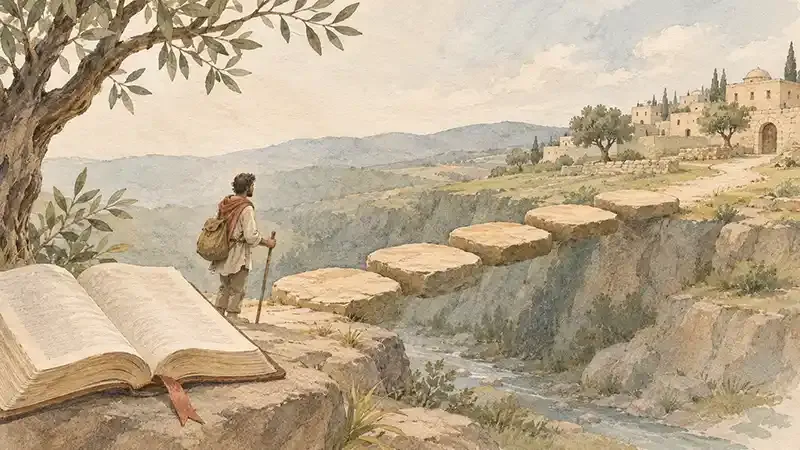
A lot of people genuinely want to read the Bible. Maybe you picked it up hoping for a little peace, a bit of wisdom, or honest answers to big life questions.
Instead, after a few pages, you felt like you had been dropped into a foreign country without a map. The customs felt strange, the wording felt distant, and you quietly wondered, "What does any of this have to do with my life on a Tuesday morning?"
If you have ever felt that way, please know you are in good company. That feeling of distance is completely normal. The Bible was written thousands of years ago, in a world very different from ours.
Between the ancient world and today sit five main gaps. Once you know what they are, they stop being walls that keep you out—and start becoming bridges you can actually walk across.
1. The Time Gap
The newest parts of the Bible were written nearly 2,000 years ago. The oldest parts go back more than 3,000 years.
That means the people in these pages lived long before smartphones, modern medicine, airplanes, or even printed books. When you read about ancient travelers worrying about walking through the hills, it is easy to skim right past it:
I look up to the mountains-- does my help come from there? My help comes from the LORD, who made heaven and earth!( Psalms 121:1-2 )
In the ancient world, travel was slow and dangerous. Hills were often where bandits hid or where rival shrines stood. When this writer looked up at the mountains and asked where his help would come from, he wasn't admiring the scenery—he was feeling real fear on a dark road.
How to cross this gap: Look past the ancient setting to the human feeling underneath. Technology changes every few years, but fear, hope, loneliness, and the need for safety haven't changed at all.
2. The Culture Gap
Every culture has unspoken rules about what is polite, what is shameful, and how people treat one another. Without knowing those unspoken rules, we can easily miss the most moving parts of a Bible story.
Take two famous scenes from the life of Jesus:
So he got up from the table, took off his robe, wrapped a towel around his waist, and poured water into a basin. Then he began to wash the disciples' feet, drying them with the towel he had around him.( John 13:4-5 )
"So he returned home to his father. And while he was still a long way off, his father saw him coming. Filled with love and compassion, he ran to his son, embraced him, and kissed him.( Luke 15:20 )
In the first scene, Jesus washes his friends' feet. In a world of dusty roads and open sandals, washing feet was the dirtiest job in the house—reserved for the lowest servant. Seeing a respected teacher kneel down with a towel would have shocked everyone in the room.
In the second scene, Jesus tells a story about a father who sees his runaway son coming home and runs to meet him. In that ancient culture, dignified older men never ran in public. The father was willing to look foolish just to welcome his hurting child home.
How to cross this gap: Whenever a detail in a story feels odd or unusually specific, pause and ask, "What would this have meant in their everyday world?" A quick note in a study Bible or a simple search on the custom often unlocks the whole scene.
3. The Language Gap
The Bible was originally written in three ancient languages: Hebrew, Aramaic, and Greek. Even the best modern translations have to make tough choices, because one word in an ancient language often carries a much bigger meaning than a single word in our language today.
Look at two familiar passages:
'May the LORD bless you and protect you. May the LORD smile on you and be gracious to you. May the LORD show you his favor and give you his peace.'( Numbers 6:24-26 )
Love is patient and kind. Love is not jealous or boastful or proud or rude. It does not demand its own way. It is not irritable, and it keeps no record of being wronged. It does not rejoice about injustice but rejoices whenever the truth wins out. Love never gives up, never loses faith, is always hopeful, and endures through every circumstance.( 1 Corinthians 13:4-7 )
In the first passage, the word translated as peace is the Hebrew word shalom. It doesn't just mean "no fighting" or "a quiet afternoon." It means wholeness, health, safety, and everything being right with the world.
In the second passage, the word translated as love is the Greek word agape. It isn't talking about a passing romantic feeling; it describes a steady, loyal choice to care for someone's well-being, even when it costs you something.
How to cross this gap: You don't need to learn ancient languages. Just try reading a passage in two different modern translations side by side. Seeing how two translators phrase the same sentence helps you catch the deeper flavor of the original words.
4. The Context Gap
Imagine walking into a room and hearing someone say, "I can't believe you did that!" Without knowing what happened five minutes earlier, you have no idea if they are angry, thrilled, or joking.
The same thing happens when we read one isolated Bible verse by itself. One of the most quoted verses in the world is often handed to hurting people as a quick fix:
And we know that God causes everything to work together for the good of those who love God and are called according to his purpose for them.( Romans 8:28 )
When you read it alone, it can sound dismissive—as if pain doesn't matter. But when you read the verses right before and right after it, the tone changes completely:
Yet what we suffer now is nothing compared to the glory he will reveal to us later.( Romans 8:18 )
Can anything ever separate us from Christ's love? Does it mean he no longer loves us if we have trouble or calamity, or are persecuted, or hungry, or destitute, or in danger, or threatened with death? (As the Scriptures say, "For your sake we are killed every day; we are being slaughtered like sheep.") No, despite all these things, overwhelming victory is ours through Christ, who loved us. And I am convinced that nothing can ever separate us from God's love. Neither death nor life, neither angels nor demons, neither our fears for today nor our worries about tomorrow-- not even the powers of hell can separate us from God's love. No power in the sky above or in the earth below-- indeed, nothing in all creation will ever be able to separate us from the love of God that is revealed in Christ Jesus our Lord.( Romans 8:35-39 )
Paul wasn't telling people to slap a smile on their pain. He was writing to a struggling community facing real hardship, reminding them that even in the darkest moments, nothing can cut them off from God's love.
How to cross this gap: Never read just one verse. Read the paragraph before it and the paragraph after it. Knowing who is speaking—and what they are going through—turns a flat slogan into a deeply human conversation.
5. The Application Gap
This is the gap that matters most to everyday readers: Okay, I understand what this meant back then. What does it mean for my life today?
Many ancient instructions were written for specific situations that don't exist anymore. For example, look at this Old Testament building rule:
"When you build a new house, you must build a railing around the edge of its flat roof. That way you will not be considered guilty of murder if someone falls from the roof.( Deuteronomy 22:8 )
In ancient Israel, houses had flat roofs where families ate dinner and visited with guests. Putting a low wall around the roof kept people from falling off.
Most of us don't host dinner on a flat roof today. Does that mean the verse is useless? Not at all. Behind the ancient rule is a timeless principle: take responsibility for the safety of the people around you. Today, that might look like shoveling an icy sidewalk, driving carefully, or looking out for a coworker.
Other times, the bridge from then to now is even shorter:
Understand this, my dear brothers and sisters: You must all be quick to listen, slow to speak, and slow to get angry.( James 1:19 )
Being quick to listen and slow to get angry mattered in ancient town squares, and it matters just as much in modern comment sections and family group chats.
How to cross this gap: Don't ask, "How do I copy this ancient habit word for word?" Instead, ask, "What timeless principle of love, wisdom, or fairness is sitting underneath this?"
You don't have to cross all five at once
Reading an ancient library takes patience, and it is completely okay to go slow. You don't need to become a historian overnight, and you don't need to have every single verse figured out.
The next time you open the Bible and feel that familiar wave of distance, be gentle with yourself. Remember that you are simply looking across a bridge of time, culture, and language. Take one small step, ask an honest question, and give the text a little room to meet you where you are.
Keep exploring
If you have ever opened the Bible, read a strange line about trees clapping their hands or a seven-headed beast rising from the sea, and quietly…
If you have ever read the Old Testament and then flipped to the New Testament, you might feel like you just walked into a completely different book.…
If you have ever tried to read the Bible from page one, you probably know how it ends. You start strong in Genesis, push through the drama of Exodus,…