
Who is Jesus, and why does he matter so much?
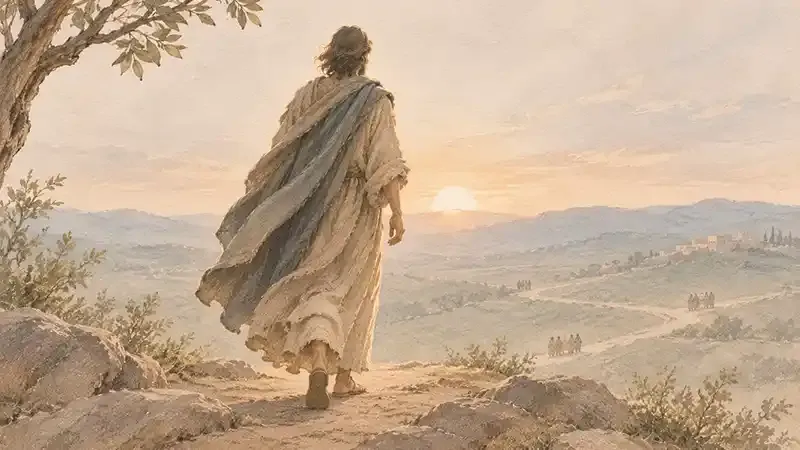
Who is Jesus?
Human? A prophet? A Son of God, or God himself? Is there something truly special in him?
He was the cornerstone the builders missed, rejected by the experts of the Torah, a stone that made humanity stumble. And yet he became the most famous person who has ever lived on Earth. His life and his teachings divided humanity into three great Abrahamic religions.
What is so special in what he did for humanity? How did it happen, and why? Let's find out.
A servant promised long ago
About 700 years before Jesus, the prophet Isaiah described a coming "Servant" of God. Notice what kind of strength he promised.
"Look at my servant, whom I strengthen. He is my chosen one, who pleases me. I have put my Spirit upon him. He will bring justice to the nations. He will not shout or raise his voice in public. He will not crush the weakest reed or put out a flickering candle. He will bring justice to all who have been wronged. He will not falter or lose heart until justice prevails throughout the earth. Even distant lands beyond the sea will wait for his instruction. "( Isaiah 42:1-4 )
God, the LORD, created the heavens and stretched them out. He created the earth and everything in it. He gives breath to everyone, life to everyone who walks the earth. And it is he who says, "I, the LORD, have called you to demonstrate my righteousness. I will take you by the hand and guard you, and I will give you to my people, Israel, as a symbol of my covenant with them. And you will be a light to guide the nations. You will open the eyes of the blind. You will free the captives from prison, releasing those who sit in dark dungeons.( Isaiah 42:5-7 )
A Servant who does not shout was not what people expected from a rescuer. His power would come from gentleness, and from a mission wider than one nation: "light to the nations." Isaiah wrote in a time of war and exile, when hope was fragile, and these verses became one of the most treasured promises in Jewish scripture.
No bonuses
Now Isaiah describes the Servant's whole path, and the surprise is how ordinary it begins.
See, my servant will prosper; he will be highly exalted. But many were amazed when they saw him. His face was so disfigured he seemed hardly human, and from his appearance, one would scarcely know he was a man. And he will startle many nations. Kings will stand speechless in his presence. For they will see what they had not been told; they will understand what they had not heard about.( Isaiah 52:13-15 )
My servant grew up in the LORD's presence like a tender green shoot, like a root in dry ground. There was nothing beautiful or majestic about his appearance, nothing to attract us to him.( Isaiah 53:2 )
This is the heart of the story: Jesus came with no bonuses. The Bible gives no description of his face or build, and Isaiah says nothing about his looks was meant to draw a crowd. The disfigurement in 52:14 describes what the cross did to him, not his ordinary appearance. He had no thundering voice, no royal palace, no wealth, no army. Everything he won, he won through love, truth and humility. That is why his story still reaches people who have no bonuses of their own: the poor, the overlooked, the ordinary. If you have ever felt unnoticed, notice how he began.
Despised, yet carrying our pain
The Dead Sea Scrolls include a copy of Isaiah more than 2,000 years old, so these words were safely written before Jesus was born.
He was despised and rejected-- a man of sorrows, acquainted with deepest grief. We turned our backs on him and looked the other way. He was despised, and we did not care. Yet it was our weaknesses he carried; it was our sorrows that weighed him down. And we thought his troubles were a punishment from God, a punishment for his own sins! But he was pierced for our rebellion, crushed for our sins. He was beaten so we could be whole. He was whipped so we could be healed. All of us, like sheep, have strayed away. We have left God's paths to follow our own. Yet the LORD laid on him the sins of us all.( Isaiah 53:3-6 )
He was oppressed and treated harshly, yet he never said a word. He was led like a lamb to the slaughter. And as a sheep is silent before the shearers, he did not open his mouth. Unjustly condemned, he was led away. No one cared that he died without descendants, that his life was cut short in midstream. But he was struck down for the rebellion of my people. He had done no wrong and had never deceived anyone. But he was buried like a criminal; he was put in a rich man's grave.( Isaiah 53:7-9 )
When he sees all that is accomplished by his anguish, he will be satisfied. And because of his experience, my righteous servant will make it possible for many to be counted righteous, for he will bear all their sins. I will give him the honors of a victorious soldier, because he exposed himself to death. He was counted among the rebels. He bore the sins of many and interceded for rebels.( Isaiah 53:11-12 )
Isaiah's "many" and "transgressors" are all of us. The picture is of someone who chooses to stand where the hurting stand, and to bear what they cannot. Early Christians read this chapter as pointing to Jesus; many Jewish readers have understood it as describing Israel. We can simply read it carefully and let it speak.
A king from David's line
Two more promises complete the portrait: a righteous king from David's family, and a stone that builders would throw away.
"For the time is coming," says the LORD, "when I will raise up a righteous descendant from King David's line. He will be a King who rules with wisdom. He will do what is just and right throughout the land.( Jeremiah 23:5 )
The stone that the builders rejected has now become the cornerstone. This is the LORD's doing, and it is wonderful to see.( Psalms 118:22-23 )
Builders shaped stones for the corner of a building, the one that holds two walls together. A rejected stone becoming the very piece that holds everything is a startling image, written many centuries before Jesus. It was sung by pilgrims walking up to Jerusalem, so everyone in his day knew it by heart.
Born without privilege
Jesus was born in David's line, yet in a manger, and raised in Nazareth, a village few people noticed. Luke tells of shepherds, the humblest of witnesses, as his first visitors. Here is how his own neighbors saw him years later.
Then they scoffed, "He's just the carpenter's son, and we know Mary, his mother, and his brothers-- James, Joseph, Simon, and Judas. All his sisters live right here among us. Where did he learn all these things?" And they were deeply offended and refused to believe in him.Then Jesus told them, "A prophet is honored everywhere except in his own hometown and among his own family."( Matthew 13:55-57 )
But Jesus replied, "Foxes have dens to live in, and birds have nests, but the Son of Man has no place even to lay his head."( Matthew 8:20 )
"The carpenter's son" was a way of saying "we know exactly who you are." Their familiarity became the obstacle. The same Jesus had no home of his own. Born into a poor family, he spent about thirty years in quiet obscurity before his public work began.
The stone many stumbled over
As the Scriptures say, "I am placing a cornerstone in Jerusalem, chosen for great honor, and anyone who trusts in him will never be disgraced." Yes, you who trust him recognize the honor God has given him. But for those who reject him, "The stone that the builders rejected has now become the cornerstone." And, "He is the stone that makes people stumble, the rock that makes them fall." They stumble because they do not obey God's word, and so they meet the fate that was planned for them.( 1 Peter 2:6-8 )
Peter, one of Jesus' closest friends, wrote this after seeing the rejection himself, and he quotes the same cornerstone psalm we met earlier. Those who stumbled were not villains; they expected a different kind of Messiah.
The stone that divided the world
Here is why one man divided the world. Three great faiths trace their roots to Abraham, and each answers "who is Jesus?" differently. Judaism does not accept him as the Messiah and still waits for the Messiah to come. Islam honors him as a prophet and as the Messiah and expects his return, yet it does not accept that he is the Son of God or that he died on the cross. Christianity confesses him as the Son of God and Savior. In this way his life and teachings divided humanity into three major Abrahamic religions, and the rejection is still with us today.
What astonishes Christians is that this was foretold. The scriptures that Jews and Christians share, the Old Testament, had already said that the promised servant would be despised and rejected, as we saw in Isaiah 53 and Psalm 118. Isaiah even named who would stumble, and John, himself a Jew, tells us it happened:
He will keep you safe. But to Israel and Judah he will be a stone that makes people stumble, a rock that makes them fall. And for the people of Jerusalem he will be a trap and a snare. Many will stumble and fall, never to rise again. They will be snared and captured."( Isaiah 8:14-15 )
He came to his own people, and even they rejected him.( John 1:11 )
Israel and Judah were the very people who had waited longest. Jesus grieved over it, but his last words here are not a goodbye:
"O Jerusalem, Jerusalem, the city that kills the prophets and stones God's messengers! How often I have wanted to gather your children together as a hen protects her chicks beneath her wings, but you wouldn't let me. And now, look, your house is abandoned and desolate. For I tell you this, you will never see me again until you say, 'Blessings on the one who comes in the name of the Lord!' "( Matthew 23:37-39 )
The prophets also promise a day of recognition, when the rejected one is finally seen for who he is:
"Then I will pour out a spirit of grace and prayer on the family of David and on the people of Jerusalem. They will look on me whom they have pierced and mourn for him as for an only son. They will grieve bitterly for him as for a firstborn son who has died.( Zechariah 12:10 )
So for Christians the division is not a defeat. It was part of the story from the start, and the story is not finished. We can respect our neighbors of every faith, and still gently invite everyone to look again. So who is he, according to the Bible? Here is its own answer, offered as a gift to consider, never a demand.
Who he really is
In the beginning the Word already existed. The Word was with God, and the Word was God. He existed in the beginning with God. God created everything through him, and nothing was created except through him. So the Word became human and made his home among us. He was full of unfailing love and faithfulness. And we have seen his glory, the glory of the Father's one and only Son.( John 1:1-3,14 )
Christ is the visible image of the invisible God. He existed before anything was created and is supreme over all creation, for through him God created everything in the heavenly realms and on earth. He made the things we can see and the things we can't see-- such as thrones, kingdoms, rulers, and authorities in the unseen world. Everything was created through him and for him. He existed before anything else, and he holds all creation together.( Colossians 1:15-17 )
Without question, this is the great mystery of our faith: Christ was revealed in a human body and vindicated by the Spirit. He was seen by angels and announced to the nations. He was believed in throughout the world and taken to heaven in glory.( 1 Timothy 3:16 )
John wrote his Gospel as an eyewitness, Paul wrote to the church in Colossae, and the line in 1 Timothy may be an early Christian hymn. Three writers, one conviction: the Creator himself entered human life, with all its hunger and tears. Paul wrote Colossians while in prison, which makes its confidence about Jesus' greatness even more striking. "Firstborn" there means first in rank and honor, not first created. That is why Christians call Jesus the Son of God.
The greatest chose the lowest place
Though he was God, he did not think of equality with God as something to cling to. Instead, he gave up his divine privileges; he took the humble position of a slave and was born as a human being. When he appeared in human form, he humbled himself in obedience to God and died a criminal's death on a cross.( Philippians 2:6-8 )
Jesus knew that the Father had given him authority over everything and that he had come from God and would return to God. So he got up from the table, took off his robe, wrapped a towel around his waist, and poured water into a basin. Then he began to wash the disciples' feet, drying them with the towel he had around him.( John 13:3-5 )
After washing their feet, he put on his robe again and sat down and asked, "Do you understand what I was doing? You call me 'Teacher' and 'Lord,' and you are right, because that's what I am. And since I, your Lord and Teacher, have washed your feet, you ought to wash each other's feet. I have given you an example to follow. Do as I have done to you.( John 13:12-15 )
In Jesus' day, washing feet was the work of the lowest servant, and the disciples had just been arguing about who was greatest. Philippians 2 shows his choice to give up royal comfort; the upper room shows what that choice looked like in a towel and a basin. Greatness, in his kingdom, is measured by how low someone is willing to bend.
Serving and forgiving
For even the Son of Man came not to be served but to serve others and to give his life as a ransom for many."( Mark 10:45 )
Jesus said, "Father, forgive them, for they don't know what they are doing." And the soldiers gambled for his clothes by throwing dice.( Luke 23:34 )
Mark's words come from Jesus' own explanation of his life. Luke's come from the cross itself, where the one being wronged asked for mercy for those wronging him. Love that forgives its executioners is rare in any age.
What he did, and why
For he has rescued us from the kingdom of darkness and transferred us into the Kingdom of his dear Son, who purchased our freedom and forgave our sins.( Colossians 1:13-14 )
Christ is also the head of the church, which is his body. He is the beginning, supreme over all who rise from the dead. So he is first in everything. For God in all his fullness was pleased to live in Christ, and through him God reconciled everything to himself. He made peace with everything in heaven and on earth by means of Christ's blood on the cross.( Colossians 1:18-20 )
"For God loved the world so much that he gave his one and only Son, so that everyone who believes in him will not perish but have eternal life. God sent his Son into the world not to judge the world, but to save the world through him.( John 3:16-17 )
But God showed his great love for us by sending Christ to die for us while we were still sinners.( Romans 5:8 )
"Peace through the blood of his cross" means Jesus gave his life willingly, and that his rising on the third day showed death does not have the last word. For Christians, this is the center of the whole story: God himself paying the cost of reaching us. Many people see the cross only as tragedy; these writers saw it as the greatest act of love in history. Notice the motive in every verse: not anger, not duty, but love, offered while we were still far from him.
Lifted up
Therefore, God elevated him to the place of highest honor and gave him the name above all other names, that at the name of Jesus every knee should bow, in heaven and on earth and under the earth, and every tongue confess that Jesus Christ is Lord, to the glory of God the Father.( Philippians 2:9-11 )
The one who came without bonuses is given the highest honor, not by force, but by the Father. Humility was never weakness, and it did not end at the cross; it was the way of the King all along. Every knee bowing is a picture of joyful recognition, the reverse of the rejection he first faced.
An open door
After all these centuries, the question of who Jesus is remains the most personal one anyone can ask. You are welcome to read the Gospels slowly, ask your questions, and see for yourself. Jesus never pushes. He simply invites. In the final book of the Bible, he does not break the door down. He knocks, and waits for us to open it from the inside, when we are ready.
"Look! I stand at the door and knock. If you hear my voice and open the door, I will come in, and we will share a meal together as friends.( Revelation 3:20 )