
Jacob wrestled with God and won. What does that mean?
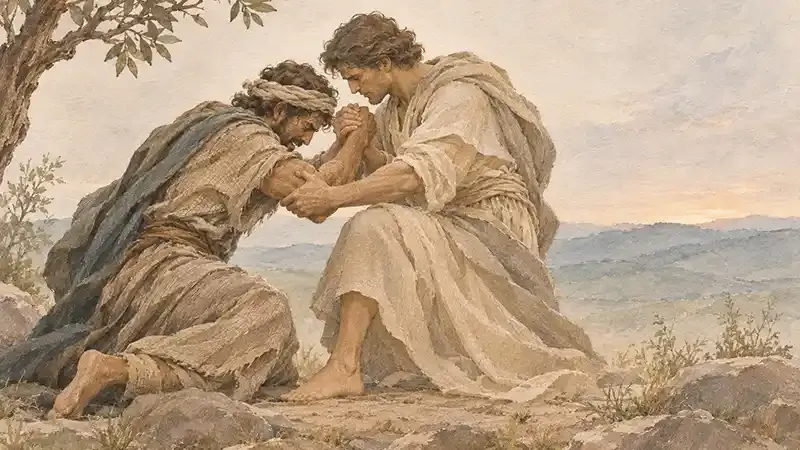
When Jacob was on his way home to meet his brother Esau, he wrestled through the night with God, and at dawn he was told that he had won. What does that mean? How can a mere human win against God?
The night at the river
Jacob was coming back after twenty years away. He had once left home because Esau wanted to kill him. Now he heard that Esau was coming to meet him with an army:
After delivering the message, the messengers returned to Jacob and reported, "We met your brother, Esau, and he is already on his way to meet you-- with an army of 400 men!" Jacob was terrified at the news. He divided his household, along with the flocks and herds and camels, into two groups.( Genesis 32:6-7 )
That night Jacob sent his family across the river Jabbok and stayed behind alone:
This left Jacob all alone in the camp, and a man came and wrestled with him until the dawn began to break. When the man saw that he would not win the match, he touched Jacob's hip and wrenched it out of its socket. Then the man said, "Let me go, for the dawn is breaking!" But Jacob said, "I will not let you go unless you bless me." "What is your name?" the man asked.He replied, "Jacob." "Your name will no longer be Jacob," the man told him. "From now on you will be called Israel, because you have fought with God and with men and have won."( Genesis 32:24-28 )
Notice what the story says. It does not say Jacob overpowered God. The man could not end the struggle, and with a single touch of the hip he showed who was truly stronger. What Jacob won was a blessing, because he would not let go until he received it. To see why this night matters, we need to see who Jacob had been, and the prophet Hosea helps us do that.
Hosea holds up a mirror
Hosea lived many centuries later and spoke to Israel, the people who descended from Jacob and had drifted away from God. He retold Jacob's life so that they could see themselves in it:
Now the LORD is bringing charges against Judah. He is about to punish Jacob for all his deceitful ways, and pay him back for all he has done. Even in the womb, Jacob struggled with his brother; when he became a man, he even fought with God. Yes, he wrestled with the angel and won. He wept and pleaded for a blessing from him. There at Bethel he met God face to face, and God spoke to him-- the LORD God of Heaven's Armies, the LORD is his name! So now, come back to your God. Act with love and justice, and always depend on him.( Hosea 12:2-6 )
Hosea mentions the struggle and the scheming, but he also remembers that Jacob wept and pleaded. He ends with an invitation, not a verdict: "come back to your God."
A life of grasping
Jacob's name is linked to the moment of his birth, when he came out holding his twin brother's heel. Before the twins were born, God had told their mother something that matters here:
And the LORD told her, "The sons in your womb will become two nations. From the very beginning, the two nations will be rivals. One nation will be stronger than the other; and your older son will serve your younger son."( Genesis 25:23 )
Jacob did not have to scheme to receive what God had already planned. But he did. He bought Esau's birthright while his brother was starving:
"All right," Jacob replied, "but trade me your rights as the firstborn son." "Look, I'm dying of starvation!" said Esau. "What good is my birthright to me now?" But Jacob said, "First you must swear that your birthright is mine." So Esau swore an oath, thereby selling all his rights as the firstborn to his brother, Jacob.( Genesis 25:31-33 )
He later deceived his blind father Isaac by pretending to be Esau, to receive the blessing meant for the firstborn:
Jacob replied, "It's Esau, your firstborn son. I've done as you told me. Here is the wild game. Now sit up and eat it so you can give me your blessing."( Genesis 27:19 )
Working for his uncle Laban, he found a clever way to build up his own flocks at Laban's expense. Laban had treated him unfairly too, but Jacob answered cunning with cunning:
Whenever the stronger females were ready to mate, Jacob would place the peeled branches in the watering troughs in front of them. Then they would mate in front of the branches. But he didn't do this with the weaker ones, so the weaker lambs belonged to Laban, and the stronger ones were Jacob's.( Genesis 30:41-42 )
And in the end he left Laban's house secretly, without saying goodbye:
Jacob outwitted Laban the Aramean, for they set out secretly and never told Laban they were leaving. So Jacob took all his possessions with him and crossed the Euphrates River, heading for the hill country of Gilead.( Genesis 31:20-21 )
All of this came after God had spoken to him in a dream and promised to be with him:
What's more, I am with you, and I will protect you wherever you go. One day I will bring you back to this land. I will not leave you until I have finished giving you everything I have promised you."( Genesis 28:15 )
Jacob did not trust that promise. He tried to secure the blessing on his own.
Wrestling against the path
In that sense, Jacob was struggling against God long before that night at the river. He was resisting the path God had laid out for him and trying to reach the goal by his own route. King David, in a psalm about the cost of resisting God and the relief of being forgiven, describes what God offers instead:
The LORD says, "I will guide you along the best pathway for your life. I will advise you and watch over you. Do not be like a senseless horse or mule that needs a bit and bridle to keep it under control."( Psalms 32:8-9 )
God does not want to drag us like a stubborn animal. He offers to guide us, if we will let Him.
He asked, and God gave
Even so, Jacob refused to let go until he was blessed, and God gave it. He received a new name, Israel, and his twelve sons became the twelve tribes of a whole nation. When he finally met Esau, his greatest fear melted away:
Then Esau ran to meet him and embraced him, threw his arms around his neck, and kissed him. And they both wept.( Genesis 33:4 )
But the nation that carried his name often followed his old pattern: drifting, struggling, then coming back. Centuries later, God spoke through Isaiah about it:
All day long I opened my arms to a rebellious people. But they follow their own evil paths and their own crooked schemes. All day long they insult me to my face by worshiping idols in their sacred gardens. They burn incense on pagan altars. At night they go out among the graves, worshiping the dead. They eat the flesh of pigs and make stews with other forbidden foods.( Isaiah 65:2-4 )
God's arms were open "all day long". That is the same patience Jacob met at the river.
A Son who did not wrestle
Many years later, one person appeared who did not struggle against God's path. On the night before His death, Jesus prayed in a garden and asked that the suffering ahead might be taken away. Then He gave Himself to the Father's plan:
He went on a little farther and bowed with his face to the ground, praying, "My Father! If it is possible, let this cup of suffering be taken away from me. Yet I want your will to be done, not mine."( Matthew 26:39 )
Where Jacob wrestled to get his way, Jesus yielded His. In Him we see what the path looks like when it is walked without a fight.
What this means for us
So we need not wrestle with God. David wrote of what it cost him to resist, and of what he found when he finally stopped hiding:
When I refused to confess my sin, my body wasted away, and I groaned all day long. Day and night your hand of discipline was heavy on me. My strength evaporated like water in the summer heat. Interlude Finally, I confessed all my sins to you and stopped trying to hide my guilt. I said to myself, "I will confess my rebellion to the LORD." And you forgave me! All my guilt is gone. Interlude( Psalms 32:3-5 )
That is the invitation Hosea repeated to Israel: come back. And the book of Proverbs puts it simply:
Trust in the LORD with all your heart; do not depend on your own understanding. Seek his will in all you do, and he will show you which path to take.( Proverbs 3:5-6 )
Like Jacob, we may be held by God for a long night. The good news is that He is not our opponent in the struggle. He is the One we are really asking for the blessing.