
The importance of promise
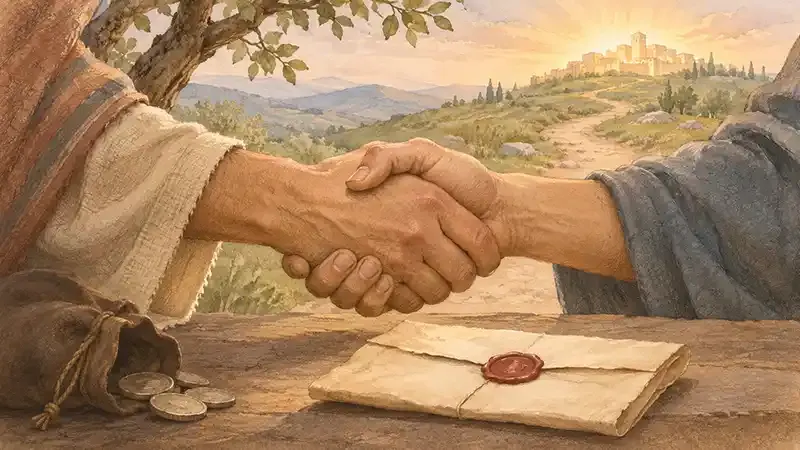
What we cannot see is still real
We live in a visible, practical world, and it is easy to underestimate what we cannot see. Righteousness that costs us something, whether money, comfort or health, can look like a loss. A friendship can seem less important when it stops being useful. And a promise can start to feel optional when keeping it is no longer to our advantage.
Yet the Bible treats a promise as something very valuable. Keeping our word is one of the foundations of the heavenly kingdom that we hope to be part of. It prepares us for that kingdom, and it makes this world better right now, by bringing in values that are neither riches nor power. Let's look together at what the Bible says about promises.
The One who keeps every promise
Everything starts with God himself. He is the model of someone whose word can be trusted completely:
God is not a man, so he does not lie. He is not human, so he does not change his mind. Has he ever spoken and failed to act? Has he ever promised and not carried it through?( Numbers 23:19 )
When we keep our promises, we reflect a little of who God is. And that is exactly what makes the world around us feel safer and warmer.
Who can live close to God?
The psalmist asks a question that every one of us has asked at some point: who may live in God's presence? His answer is a description of a person of integrity, and one detail in it speaks directly to our topic:
Who may worship in your sanctuary, LORD? Who may enter your presence on your holy hill? Those who lead blameless lives and do what is right, speaking the truth from sincere hearts. Those who refuse to gossip or harm their neighbors or speak evil of their friends. Those who despise flagrant sinners, and honor the faithful followers of the LORD, and keep their promises even when it hurts.( Psalms 15:1-4 )
"Keeps promises even when it hurts." That is the point where most of us struggle. It is easy to keep a promise that costs nothing. A promise shows its value when it costs us something.
Think before you promise
The Law of Moses took promises very seriously, and it was also very kind to those who were afraid of making them. Nobody was required to make a vow. But once someone made one to God, it was to be kept without delay:
"When you make a vow to the LORD your God, be prompt in fulfilling whatever you promised him. For the LORD your God demands that you promptly fulfill all your vows, or you will be guilty of sin. However, it is not a sin to refrain from making a vow. But once you have voluntarily made a vow, be careful to fulfill your promise to the LORD your God.( Deuteronomy 23:21-23 )
The idea is simple and gentle. We don't have to promise a lot. We only need to mean what we say.
The Law also recognized that we sometimes promise too quickly, in the heat of the moment, not realizing what we are saying. It gives a way forward: when we realize it, we are invited to be honest about it.
"Or suppose you make a foolish vow of any kind, whether its purpose is for good or for bad. When you realize its foolishness, you must admit your guilt.( Leviticus 5:4 )
When a promise is made in anger
Here is a story that shows how easily this can happen. David and his men had protected the herds of a wealthy man named Nabal. When David asked for some food in return, Nabal insulted him and sent his men away. David was furious, and in his anger he made a vow that every man in Nabal's house would die by morning:
May God strike me and kill me if even one man of his household is still alive tomorrow morning!"( 1 Samuel 25:22 )
Nabal's wife, Abigail, heard about it and hurried to meet David with food and wise words. David listened. He realized how close he had come to a serious wrong, and he thanked her:
For I swear by the LORD, the God of Israel, who has kept me from hurting you, that if you had not hurried out to meet me, not one of Nabal's men would still be alive tomorrow morning."( 1 Samuel 25:34 )
This story shows two things. A promise made in a rage can become a trap for us and for other people. And a wise person, who dares to speak calmly, can prevent a disaster. David did not insist on being "consistent." He chose to step back, and that is also a part of integrity: having the humility to accept that we were wrong.
A promise has two sides
God's promises are always faithful, but the way they are received can depend on how we respond. A priest named Eli had been promised that his family would serve God for generations. But Eli's sons used their position to take advantage of the people. God sent a message to Eli:
"Therefore, the LORD, the God of Israel, says: I promised that your branch of the tribe of Levi would always be my priests. But I will honor those who honor me, and I will despise those who think lightly of me.( 1 Samuel 2:30 )
This is not about a God who withdraws his word easily. It shows that every promise between us and God is a relationship. It invites us to answer with respect and honor.
When a promise is treated lightly
The last king of Judah, Zedekiah, had been made king by Babylon, and he had promised loyalty to the Babylonian king in God's name. Then he broke that promise and turned to Egypt for help:
He also rebelled against King Nebuchadnezzar, even though he had taken an oath of loyalty in God's name. Zedekiah was a hard and stubborn man, refusing to turn to the LORD, the God of Israel.( 2 Chronicles 36:13 )
The prophet Ezekiel describes how this was seen. A promise sworn in God's name is not only a promise to a person. It is also something we say before God:
For the king of Israel disregarded his treaty and broke it after swearing to obey; therefore, he will not escape.( Ezekiel 17:18 )
A few generations later the prophet Zechariah saw a vision of a huge flying scroll that went out over the land. It carried a warning against those who steal and those who swear falsely by God's name:
And this is what the LORD of Heaven's Armies says: I am sending this curse into the house of every thief and into the house of everyone who swears falsely using my name. And my curse will remain in that house and completely destroy it-- even its timbers and stones."( Zechariah 5:4 )
We don't need to read this as a threat. It shows that God cares deeply about honesty, because lies and broken promises hurt real people, usually the ones who trust the most.
Simply yes, simply no
Jesus offers us a simpler way, one that doesn't need big oaths. If our word can be trusted, we don't need to add anything to it:
Just say a simple, 'Yes, I will,' or 'No, I won't.' Anything beyond this is from the evil one.( Matthew 5:37 )
His brother James repeated the same advice:
But most of all, my brothers and sisters, never take an oath, by heaven or earth or anything else. Just say a simple yes or no, so that you will not sin and be condemned.( James 5:12 )
A person who always keeps their word doesn't need to promise on heaven or earth. Their "yes" is already enough.
If we have broken a promise
Most of us have broken promises at some point. Perhaps we didn't mean to, or we wanted to but didn't have the strength. The Bible does not leave us there. It invites us to be honest, to make things right where we can, and to turn to God, who is kind to people who come to him humbly:
But if we confess our sins to him, he is faithful and just to forgive us our sins and to cleanse us from all wickedness.( 1 John 1:9 )
If this is on your heart today, you are welcome to start with a short prayer. Tell God about the promise you couldn't keep, and ask him for forgiveness and for strength. Then, if you can, talk to the person you let down.
And for the future, we can start with small things: keep the little promises, be on time, return the call, finish what we said we would do. When our "yes" means yes, we are building something that cannot be seen, but that lasts: trust, and a character that fits the kingdom of heaven.